MYC (MYC proto-oncogene, bHLH transcription factor)
2017-08-01 Anwar N Mohamed AffiliationCytogenetics Laboratory, Pathology Department, Detroit Medical Center, Wayne State University School of Medicine, Detroit, MI USA; [email protected]
Identity
HGNC
LOCATION
8q24.21
IMAGE

LEGEND
MYC (8q24) in normal cells: PAC 944B18 (top) and PAC 968N11 (below) - Courtesy Mariano Rocchi, Resources for Molecular Cytogenetics.
IMAGE

LEGEND
MYC (MYC proto-oncogene, bHLH transcription factor) Hybridization with Vysis LSI MYC break apart and LSY MYC probe (Abbott Molecular, US) showing the gene on 8q24.21 - Courtesy Adriana Zamecnikova.
LOCUSID
ALIAS
MRTL,MYCC,bHLHe39,c-Myc
FUSION GENES
Abstract
Review the structure, function, and role of CMYC gene in tumorigenesis
DNA/RNA
Description
CMYC is composed of three exons spanning over 4 kb with the second and third exons encoding most MYC protein. These two exons have at least 70% sequence homology among species. However, exon1 is untranslated whose sequence is not as well conserved through evolution. The exon1 has been postulated to play a role in translational control and mRNA stability. There are four MYC transcriptional promoters. In normal cells, promoter P2 contributes to approximately 75% of total MYC transcripts while P1 accounts for most the remaining 25% transcripts (Dang CV 2012).
Transcription
MYC mRNA contains an IRES (internal ribosome entry site) that allows the RNA to be translated into protein when 5 cap-dependent translation is inhibited, such as during viral infection.
Proteins
Description
439 amino acids and 48 kDa in the p64; 454 amino acids in the p67 (15 additional amino acids in N-term; contains from N-term to C-term: a transactivation domain, an acidic domain, a nuclear localization signal, a basic domain, an helix-loop-helix motif, and a leucin zipper; DNA binding protein.
Expression
Expressed in almost all proliferating cells in embryonic and adult tissues; in adult tissues, expression correlates with cell proliferation; abnormally high expression is found in a wide variety of human cancers.
Localisation
located predominantly in the nucleus.
The myc protein contains an unstructured N-terminal transcriptional regulatory domain followed by a nuclear localization signal and a C-terminal region with a basic DNA-binding domain tied to a helix-loop-helix-leucine zipper (bHLHZip) dimerization motif. The bHLHzip motif of MYC dimerizes with the MAX, which is a prerequisite for specific binding to DNA at E-box sequences (5-CA(C/T)G(T/C)G-3) (Dang 2012). Upon DNA binding the MYC/MAX heterodimer recruits co-factors, which mediate multiple effects of MYC on gene expression in a context-dependent manner. This dimerization process is essential for induction of cell cycle progression, apoptosis, and transformation suggesting that MYC exerts its oncogenic effects by transactivation of target genes via E-boxes (Amati B, Land H, 1994; Grandori C et al 2000). The coding exons of MYC encode for the N-terminal region which has a transcriptional regulatory domain, a region that contains conserved MYC Boxes I and II, followed by MYC Box III and IV, and a nuclear targeting sequence. The N-terminal region will bind with co-activator complexes, making MYC acts as the transcription or repression factor (Cowling et al 2006).
In normal cells, MYC is tightly regulated by mitotic and developmental signals, and in turn, it regulates the expression of downstream target genes. Both MYC mRNA and protein have very short half-lives in normal cells (20-30 minutes each). Without appropriate positive regulatory signals, MYC protein levels are low and insufficient to promote cellular proliferation. In addition, MYC protein is rapidly degraded by the ubiquitin-linked proteasome machinery. The short-life and instability of MYC protein and mRNA together would seem to be an effective safeguard mechanism of MYC regulation (Herrick and Ross et al, 1994). However, these controls are lost in cancer cells, resulting in aberrantly high levels of MYC protein. In its physiological role, MYC is broadly expressed during embryogenesis and in tissue with high proliferative capacity such as skin epidermis and gut. Its expression strongly correlates with cell proliferation.
The myc protein contains an unstructured N-terminal transcriptional regulatory domain followed by a nuclear localization signal and a C-terminal region with a basic DNA-binding domain tied to a helix-loop-helix-leucine zipper (bHLHZip) dimerization motif. The bHLHzip motif of MYC dimerizes with the MAX, which is a prerequisite for specific binding to DNA at E-box sequences (5-CA(C/T)G(T/C)G-3) (Dang 2012). Upon DNA binding the MYC/MAX heterodimer recruits co-factors, which mediate multiple effects of MYC on gene expression in a context-dependent manner. This dimerization process is essential for induction of cell cycle progression, apoptosis, and transformation suggesting that MYC exerts its oncogenic effects by transactivation of target genes via E-boxes (Amati B, Land H, 1994; Grandori C et al 2000). The coding exons of MYC encode for the N-terminal region which has a transcriptional regulatory domain, a region that contains conserved MYC Boxes I and II, followed by MYC Box III and IV, and a nuclear targeting sequence. The N-terminal region will bind with co-activator complexes, making MYC acts as the transcription or repression factor (Cowling et al 2006).
In normal cells, MYC is tightly regulated by mitotic and developmental signals, and in turn, it regulates the expression of downstream target genes. Both MYC mRNA and protein have very short half-lives in normal cells (20-30 minutes each). Without appropriate positive regulatory signals, MYC protein levels are low and insufficient to promote cellular proliferation. In addition, MYC protein is rapidly degraded by the ubiquitin-linked proteasome machinery. The short-life and instability of MYC protein and mRNA together would seem to be an effective safeguard mechanism of MYC regulation (Herrick and Ross et al, 1994). However, these controls are lost in cancer cells, resulting in aberrantly high levels of MYC protein. In its physiological role, MYC is broadly expressed during embryogenesis and in tissue with high proliferative capacity such as skin epidermis and gut. Its expression strongly correlates with cell proliferation.
Function
MYC functions as a transcriptional regulator, capable to induce or repress the expression of a large number of genes, which are thought to mediate its biological functions (Adhikary and Eilers 2005). MYC protein cannot form homodimers, but it binds to MAX that is an obligate heterodimeric partner for MYC in mediating its functions. The MYC-MAX complex is a potent activator of transcription for a critical set of cellular target genes. Initially, two additional partners for Max had been identified, MXI1 and MXD1 (Mad1). Two more Max-interacting proteins, MXD3 (Mad3) and MXD4 (Mad4), which behave similarly to MXD1 have been reported. The transcription activation is mediated exclusively by MYC-MAX complexes, whereas MAX-MXD1 and MAX-MXI1 complexes mediate transcription repression through identical binding sites. Max expression is not highly regulated and its protein is very stable; in contrast, MXD1 protein appears to have a short half-life and to be highly regulated (Amati and Land, 1994). MXI1 protein is also regulated. MYC-MAX heterodimers activate transcription through interactions with transcriptional coactivators ( TRRAP, ACTL6A (BAF53)) and their associated histone acetyltransferases and/or ATPase/helicases, resulting in transition from the G0/1 phase to the S phase (Nilsson and Cleveland, 2003). Several studies have established that MAX is essential for MYC-mediated gene transactivation, transformation, cell cycle progression and apoptosis. On the other hand, overexpression of MXI1 and MXD1 can antagonize MYC activity in cellular transformation assays and proliferation and can diminish the malignant phenotype of tumor cells. MXD1 can also inhibit apoptosis and reverse the differentiation blocking effect of MYC in leukemia cells. (Dang 2012). These findings are consistent with the concept that MXD1 and MXI1 suppress MYC function. In addition to interacting with proteins involved in transcription regulation, MYC also interacts with enzymes controlling histone methylation.
Target Genes Thousands of MYC target genes have been identified by following mRNA levels in experimentally controlled activation of the MYC gene (Menssen and Hermeking 2002). In general, genes targeted by MYC include mediators of metabolism, biosynthesis, and cell cycle progression, such that aberrant MYC expression is associated with uncontrolled cell growth, division, and metastasis, whereas loss or inhibition of MYC expression hinders growth, promotes differentiation, and sensitizes cells to DNA damage (Miller 2012; Hsieh 2015). Different target genes are regulated under specific conditions for specific cell types. Some of the most biologically important targets are CCND2 (cyclin D2), and cyclin-dependent kinases (CDKs), resulting in accelerated cell cycling; down-regulation of PTEN (phosphatase and tensin homolog deleted on chromosome ten) with consequent up-regulation of the phosphoinositide 3-kinase/protein kinase B/mammalian target of rapamycin (PI3K/AKT/ MTOR) pathway; and stabilization of the proapoptotic protein and tumor suppressor TP53, (Hoffman and Liebermann 2008; Dang 2012) which can bypass the apoptotic BCL2 program. MYC, on the other hand, activates many ribosomal protein genes including RPL23, which binds to and retains NPM1 in the nucleolus, thereby inhibiting PIAS2 (Miz-1) activity (Wanzel, 2008). MYC itself is modulated by NPM1, which acts as a positive MYC coactivator (Schneider A 1997; Grandori C et al., 2005; Li Z, et al 2008).
MYC-targeted gene network also contains non-protein coding targets; among those are microRNAs (miRNAs). The miRNAs are 18- 22 nucleotides non-coding RNAs that negatively regulate gene expression at the post-transcriptional level via binding to 3-UTRs of target mRNAs and mediate translational repression or mRNA degradation. Some miRNA function as an oncogene while others behave as tumor suppressor gene, in a cell-typed manner. Growing evidences have suggested that MYC regulates the expression of a number of miRNAs, resulting in widespread repression of miRNA and, at the same time, MYC being subjected to regulation by miRNAs, leading to sustained MYC activity and the corresponding MYC downstream pathways (Chang et al, 2008). Thus, these combined effects of MYC overexpression and downregulation of miRNAs play a central regulatory role in the MYC oncogenic pathways. For example, MYC upregulates expression of miR-17-92 clusters a set of oncogenic miRNAs, which contains six mature miRNAs. Recently, miR-19 was identified as the key oncogenic component of this cluster (Tao et al 2014; Koh 2016). Overexpression of miR-17-92 is observed in a large fraction of human cancers, including carcinomas of the breast, lung, and colon; medulloblastomas; neuroblastomas and B-cell lymphoma. The miR17-92 is commonly amplified at 13q31 in several subtypes of aggressive lymphomas. Its oncogenic function is reflected by down-regulation of PTEN, TP53 and E2F1, causing the activation of the PI3K/AKT pathway and inhibiting cellular apoptosis. The functional interaction between miR-17`92 and MYC is further emphasized by the finding that MYC is a potent transcriptional activator of miR-17-92 (ODonnell et al. 2005), thus suggesting that miR-17-92 may contribute to the oncogenic properties of MYC. Another MYC-induced miRNA, MIR22, was recently shown to act as a potent proto-oncogenic miRNA by genome-wide deregulation of the epigenetic state through inhibition of methylcytosine dioxygenase TET proteins. In addition, MIR22 was characterized as a key regulator of self-renewal in the hematopoietic system. MYC also represses several miRNAs with tumor suppressor function such as MIR15A/ MIR16-1 and miR-34 that regulate apoptosis by targeting BCL2 and TP53 respectively. Likewise MYC is negatively regulated by several miRNAs such as miR-34 and MIR494. The auto functional interaction between MYC and miRNAs target genes maintains persistent expression of MYC, thus promoting the malignant phenotype (Tao et al 2014; Jackstadt 2015).
Furthermore, over expression of MYC can induce apoptosis. The apoptosis triggered or sensitized by MYC can be either TP53-dependent or TP53 independent, determined by the cell type and apoptotic trigger. The mechanisms of MYC-mediated apoptosis may involve several pathways. Overexpression of MYC increases DNA replication and possibly results in DNA damage that, in turn, triggers a TP53-mediated response leading to apoptosis, in some cell types (Hoffman and Libermann, 2008). As well, MYC expression seems to downregulate antiapoptotic proteins such as BCL2 or BCL2L1 (Bcl-XL) and upregulate pro-apoptotic elements such as BCL2L11 (BIM).
MYC also plays an important role in mitochondrial biogenesis. Large scale studies of gene expression in rat and human systems first suggested that MYC overexpression can induce nuclear encoded mitochondrial genes. In addition, MYC has been shown to bind to the promoters of genes encoding proteins involved in mitochondrial function. Using an inducible MYC-dependent human B cell model of cell proliferation it was shown that mitochondrial biogenesis is completely dependent on MYC expression. Moreover, the genes involved with mitochondrial biogenesis are among the MYC target genes most highly induced (Gao et al 2009).
Target Genes Thousands of MYC target genes have been identified by following mRNA levels in experimentally controlled activation of the MYC gene (Menssen and Hermeking 2002). In general, genes targeted by MYC include mediators of metabolism, biosynthesis, and cell cycle progression, such that aberrant MYC expression is associated with uncontrolled cell growth, division, and metastasis, whereas loss or inhibition of MYC expression hinders growth, promotes differentiation, and sensitizes cells to DNA damage (Miller 2012; Hsieh 2015). Different target genes are regulated under specific conditions for specific cell types. Some of the most biologically important targets are CCND2 (cyclin D2), and cyclin-dependent kinases (CDKs), resulting in accelerated cell cycling; down-regulation of PTEN (phosphatase and tensin homolog deleted on chromosome ten) with consequent up-regulation of the phosphoinositide 3-kinase/protein kinase B/mammalian target of rapamycin (PI3K/AKT/ MTOR) pathway; and stabilization of the proapoptotic protein and tumor suppressor TP53, (Hoffman and Liebermann 2008; Dang 2012) which can bypass the apoptotic BCL2 program. MYC, on the other hand, activates many ribosomal protein genes including RPL23, which binds to and retains NPM1 in the nucleolus, thereby inhibiting PIAS2 (Miz-1) activity (Wanzel, 2008). MYC itself is modulated by NPM1, which acts as a positive MYC coactivator (Schneider A 1997; Grandori C et al., 2005; Li Z, et al 2008).
MYC-targeted gene network also contains non-protein coding targets; among those are microRNAs (miRNAs). The miRNAs are 18- 22 nucleotides non-coding RNAs that negatively regulate gene expression at the post-transcriptional level via binding to 3-UTRs of target mRNAs and mediate translational repression or mRNA degradation. Some miRNA function as an oncogene while others behave as tumor suppressor gene, in a cell-typed manner. Growing evidences have suggested that MYC regulates the expression of a number of miRNAs, resulting in widespread repression of miRNA and, at the same time, MYC being subjected to regulation by miRNAs, leading to sustained MYC activity and the corresponding MYC downstream pathways (Chang et al, 2008). Thus, these combined effects of MYC overexpression and downregulation of miRNAs play a central regulatory role in the MYC oncogenic pathways. For example, MYC upregulates expression of miR-17-92 clusters a set of oncogenic miRNAs, which contains six mature miRNAs. Recently, miR-19 was identified as the key oncogenic component of this cluster (Tao et al 2014; Koh 2016). Overexpression of miR-17-92 is observed in a large fraction of human cancers, including carcinomas of the breast, lung, and colon; medulloblastomas; neuroblastomas and B-cell lymphoma. The miR17-92 is commonly amplified at 13q31 in several subtypes of aggressive lymphomas. Its oncogenic function is reflected by down-regulation of PTEN, TP53 and E2F1, causing the activation of the PI3K/AKT pathway and inhibiting cellular apoptosis. The functional interaction between miR-17`92 and MYC is further emphasized by the finding that MYC is a potent transcriptional activator of miR-17-92 (ODonnell et al. 2005), thus suggesting that miR-17-92 may contribute to the oncogenic properties of MYC. Another MYC-induced miRNA, MIR22, was recently shown to act as a potent proto-oncogenic miRNA by genome-wide deregulation of the epigenetic state through inhibition of methylcytosine dioxygenase TET proteins. In addition, MIR22 was characterized as a key regulator of self-renewal in the hematopoietic system. MYC also represses several miRNAs with tumor suppressor function such as MIR15A/ MIR16-1 and miR-34 that regulate apoptosis by targeting BCL2 and TP53 respectively. Likewise MYC is negatively regulated by several miRNAs such as miR-34 and MIR494. The auto functional interaction between MYC and miRNAs target genes maintains persistent expression of MYC, thus promoting the malignant phenotype (Tao et al 2014; Jackstadt 2015).
Furthermore, over expression of MYC can induce apoptosis. The apoptosis triggered or sensitized by MYC can be either TP53-dependent or TP53 independent, determined by the cell type and apoptotic trigger. The mechanisms of MYC-mediated apoptosis may involve several pathways. Overexpression of MYC increases DNA replication and possibly results in DNA damage that, in turn, triggers a TP53-mediated response leading to apoptosis, in some cell types (Hoffman and Libermann, 2008). As well, MYC expression seems to downregulate antiapoptotic proteins such as BCL2 or BCL2L1 (Bcl-XL) and upregulate pro-apoptotic elements such as BCL2L11 (BIM).
MYC also plays an important role in mitochondrial biogenesis. Large scale studies of gene expression in rat and human systems first suggested that MYC overexpression can induce nuclear encoded mitochondrial genes. In addition, MYC has been shown to bind to the promoters of genes encoding proteins involved in mitochondrial function. Using an inducible MYC-dependent human B cell model of cell proliferation it was shown that mitochondrial biogenesis is completely dependent on MYC expression. Moreover, the genes involved with mitochondrial biogenesis are among the MYC target genes most highly induced (Gao et al 2009).
Implicated in
Top note
MYC Deregulation
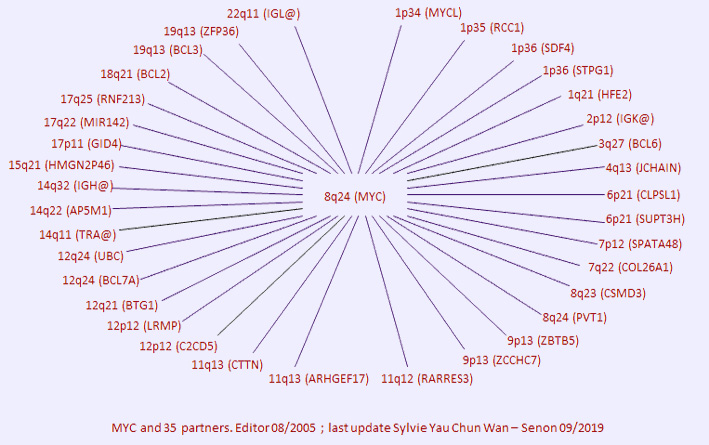
The expression of MYC is deregulated in cancer by several different mechanisms, including chromosomal translocations, amplifications, point mutations, epigenetic reprogramming, enhanced translation and increased protein stability. In most cases these alterations lead to a constitutive expression of intact MYC protein, which is normally only expressed during certain phases of the cell cycle. In Burkitt lymphoma (BL), the MYC oncogene is activated through a reciprocal t(8;14) or its variant which juxtaposes MYC/8q24 to enhancer of the immunoglobulin (Ig) heavy Chain (IGH) locus on chromosome 14q32 or the kappa or lambda light chain locus on chromosome 2 or 22. There are three main translocation breakpoints in MYC; class I breakpoints are within the exon 1 and first intron of MYC; class II breakpoints are located at the 5 end of the MYC, and usually within a few kilobases of exon 1; and the class III breakpoints are distant from MYC itself, and can be more than 100 kb away. Endemic BL typically shows class II translocation breakpoints in MYC while the sporadic BL often exhibits class I breakpoints of MYC. The t(8;14) or its variant is considered as an initiative event in BL. The MYC/8q24 translocations may also occur as secondary events in non-BL lymphomas such as diffuse large B-cell lymphoma, follicular lymphoma, mantle cell lymphoma, and multiple myeloma (Cai et al, 2015; Nguyen L, et al 2017). Secondary MYC translocation is associated with a complex karyotype and most often confer aggressive clinical behavior and poor outcome. Recently, B-cell large cell lymphoma with MYC and BCL2 or/and BCL6 rearrangements so called double hit or triple hit lymphoma are recognized by the 2016 revision of WHO as a subset of a very aggressive lymphoma (Petrich 2014). >
Amplification of MYC gene has been shown in both hematopoietic and non-hematopoietic tumors, including lung, breast, colon, and prostate cancers. Insertional mutagenesis is seen in retrovirus-induced tumors, such as avian leucosis virus (ALV)-induced hematopoietic tumors, in which the proviral enhancer is integrated upstream of the MYC gene and leads to its overexpression. MYC overexpression may also occur because of post-translational modifications. MYC protein overexpression as a result of point mutations in N-terminal domain is also frequent. The most recurrently mutated residue is Thr-58, found in lymphoma. Normally, the phosphorylation of Thr-58 can control MYC degradation and mutation causing increase of MYC protein half-life in lymphoma (Cai et al 2017). Detection of MYC rearrangement is important in the diagnosis of BL and as a prognostic marker in other aggressive B-cell lymphomas. There are several techniques to detect MYC deregulation including conventional cytogenetics, fluorescence in situ hybridization (FISH), and immunohistochemistry. In clinical laboratory, FISH is being most frequently used approach (Figure 2) >
MYC as therapeutic target
MYC is documented to be involved broadly in many cancers, in which its expression is estimated to be elevated or deregulated in up to 70% of human cancers. Overexpression of MYC protein is not only to drive tumor initiation and progression, but is also essential for tumor maintenance. Furthermore, growth arrest, apoptosis and differentiation occur upon reduction in MYC levels. These features make MYC molecule a highly attractive target for cancer therapy. However, the lack of deep pocket in the structure of MYC protein makes the traditionally small molecule inhibitors are not feasible. For this reason, other alternative strategies are proposed. One approach suggests that the disruption of the MYC/MAX binding site can be a strategy for the inactivation of MYC function in neoplastic cells. Such an approach was already applied and different small molecule inhibitors that can specifically target MYC were already successfully produced. Other approach is based on the inhibition of MYC/MAX dimers binding to E-boxes in the promoters of different MYC target genes. Other groups have focused on transcriptional inhibition of the MYC gene. Preliminary evidence from experiments using MYC antisense oligonucleotides has been encouraging, but has not translated into effective clinical treatments ( Koh 2016).
The expression of MYC is deregulated in cancer by several different mechanisms, including chromosomal translocations, amplifications, point mutations, epigenetic reprogramming, enhanced translation and increased protein stability. In most cases these alterations lead to a constitutive expression of intact MYC protein, which is normally only expressed during certain phases of the cell cycle. In Burkitt lymphoma (BL), the MYC oncogene is activated through a reciprocal t(8;14) or its variant which juxtaposes MYC/8q24 to enhancer of the immunoglobulin (Ig) heavy Chain (IGH) locus on chromosome 14q32 or the kappa or lambda light chain locus on chromosome 2 or 22. There are three main translocation breakpoints in MYC; class I breakpoints are within the exon 1 and first intron of MYC; class II breakpoints are located at the 5 end of the MYC, and usually within a few kilobases of exon 1; and the class III breakpoints are distant from MYC itself, and can be more than 100 kb away. Endemic BL typically shows class II translocation breakpoints in MYC while the sporadic BL often exhibits class I breakpoints of MYC. The t(8;14) or its variant is considered as an initiative event in BL. The MYC/8q24 translocations may also occur as secondary events in non-BL lymphomas such as diffuse large B-cell lymphoma, follicular lymphoma, mantle cell lymphoma, and multiple myeloma (Cai et al, 2015; Nguyen L, et al 2017). Secondary MYC translocation is associated with a complex karyotype and most often confer aggressive clinical behavior and poor outcome. Recently, B-cell large cell lymphoma with MYC and BCL2 or/and BCL6 rearrangements so called double hit or triple hit lymphoma are recognized by the 2016 revision of WHO as a subset of a very aggressive lymphoma (Petrich 2014). >
Amplification of MYC gene has been shown in both hematopoietic and non-hematopoietic tumors, including lung, breast, colon, and prostate cancers. Insertional mutagenesis is seen in retrovirus-induced tumors, such as avian leucosis virus (ALV)-induced hematopoietic tumors, in which the proviral enhancer is integrated upstream of the MYC gene and leads to its overexpression. MYC overexpression may also occur because of post-translational modifications. MYC protein overexpression as a result of point mutations in N-terminal domain is also frequent. The most recurrently mutated residue is Thr-58, found in lymphoma. Normally, the phosphorylation of Thr-58 can control MYC degradation and mutation causing increase of MYC protein half-life in lymphoma (Cai et al 2017). Detection of MYC rearrangement is important in the diagnosis of BL and as a prognostic marker in other aggressive B-cell lymphomas. There are several techniques to detect MYC deregulation including conventional cytogenetics, fluorescence in situ hybridization (FISH), and immunohistochemistry. In clinical laboratory, FISH is being most frequently used approach (Figure 2) >
MYC as therapeutic target
MYC is documented to be involved broadly in many cancers, in which its expression is estimated to be elevated or deregulated in up to 70% of human cancers. Overexpression of MYC protein is not only to drive tumor initiation and progression, but is also essential for tumor maintenance. Furthermore, growth arrest, apoptosis and differentiation occur upon reduction in MYC levels. These features make MYC molecule a highly attractive target for cancer therapy. However, the lack of deep pocket in the structure of MYC protein makes the traditionally small molecule inhibitors are not feasible. For this reason, other alternative strategies are proposed. One approach suggests that the disruption of the MYC/MAX binding site can be a strategy for the inactivation of MYC function in neoplastic cells. Such an approach was already applied and different small molecule inhibitors that can specifically target MYC were already successfully produced. Other approach is based on the inhibition of MYC/MAX dimers binding to E-boxes in the promoters of different MYC target genes. Other groups have focused on transcriptional inhibition of the MYC gene. Preliminary evidence from experiments using MYC antisense oligonucleotides has been encouraging, but has not translated into effective clinical treatments ( Koh 2016).
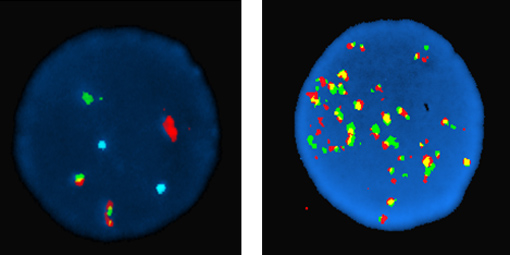
FISH using MYC/IGH/CEP8 triple color dual fusion DNA probe set, showing dual fusion pattern, consistent with t(8;14)(q24;q32) [left] in a case with Burkitt lymphoma; MYC amplification in acute myeloid leukemia [right] - Anwar N. Mohamed.
Note
MYC gene encodes a multifunctional, nuclear phosphoprotein that controls a variety of cellular functions, including cell cycle, cell growth, apoptosis, cellular metabolism and biosynthesis, adhesion, and mitochondrial biogenesis. MYC has been shown to be an essential global transcription factor capable of either promoting or repressing the expression of a massive array of genes, accounting for >15% of the human genome, commonly referred to as the "MYC signature" (Knoepfler 2007). MYC is among the most frequently affected gene in human cancers, overexpressed in most human cancers and contributes to the cause of at least 40% of tumors. Dysregulation of MYC expression results through various types of genetic alterations leading to a constitutive activity of MYC in various cancers (Dang et al, 2006).
Breakpoints
Article Bibliography
| Pubmed ID | Last Year | Title | Authors |
|---|---|---|---|
| 16064138 | 2005 | Transcriptional regulation and transformation by Myc proteins. | Adhikary S et al |
| 8193530 | 1994 | Myc-Max-Mad: a transcription factor network controlling cell cycle progression, differentiation and death. | Amati B et al |
| 26416427 | 2015 | MYC-driven aggressive B-cell lymphomas: biology, entity, differential diagnosis and clinical management. | Cai Q et al |
| 18066065 | 2008 | Widespread microRNA repression by Myc contributes to tumorigenesis. | Chang TC et al |
| 16705173 | 2006 | A conserved Myc protein domain, MBIV, regulates DNA binding, apoptosis, transformation, and G2 arrest. | Cowling VH et al |
| 22464321 | 2012 | MYC on the path to cancer. | Dang CV et al |
| 16904903 | 2006 | The c-Myc target gene network. | Dang CV et al |
| 19219026 | 2009 | c-Myc suppression of miR-23a/b enhances mitochondrial glutaminase expression and glutamine metabolism. | Gao P et al |
| 15723054 | 2005 | c-Myc binds to human ribosomal DNA and stimulates transcription of rRNA genes by RNA polymerase I. | Grandori C et al |
| 8114742 | 1994 | The half-life of c-myc mRNA in growing and serum-stimulated cells: influence of the coding and 3' untranslated regions and role of ribosome translocation. | Herrick DJ et al |
| 18955973 | 2008 | Apoptotic signaling by c-MYC. | Hoffman B et al |
| 26277543 | 2015 | MYC and metabolism on the path to cancer. | Hsieh AL et al |
| 24727092 | 2015 | MicroRNAs as regulators and mediators of c-MYC function. | Jackstadt R et al |
| 17545579 | 2007 | Myc goes global: new tricks for an old oncogene. | Knoepfler PS et al |
| 26778668 | 2016 | Targeting MYC in cancer therapy: RNA processing offers new opportunities. | Koh CM et al |
| 19033198 | 2008 | Nucleophosmin interacts directly with c-Myc and controls c-Myc-induced hyperproliferation and transformation. | Li Z et al |
| 11983916 | 2002 | Characterization of the c-MYC-regulated transcriptome by SAGE: identification and analysis of c-MYC target genes. | Menssen A et al |
| 23071356 | 2012 | c-Myc and cancer metabolism. | Miller DM et al |
| 28379189 | 2017 | The Role of c-MYC in B-Cell Lymphomas: Diagnostic and Molecular Aspects. | Nguyen L et al |
| 14663479 | 2003 | Myc pathways provoking cell suicide and cancer. | Nilsson JA et al |
| 15944709 | 2005 | c-Myc-regulated microRNAs modulate E2F1 expression. | O'Donnell KA et al |
| 25060588 | 2014 | MYC-associated and double-hit lymphomas: a review of pathobiology, prognosis, and therapeutic approaches. | Petrich AM et al |
| 9308237 | 1997 | Association of Myc with the zinc-finger protein Miz-1 defines a novel pathway for gene regulation by Myc. | Schneider A et al |
| 24394940 | 2014 | c-MYC-miRNA circuitry: a central regulator of aggressive B-cell malignancies. | Tao J et al |
| 19160485 | 2008 | A ribosomal protein L23-nucleophosmin circuit coordinates Mizl function with cell growth. | Wanzel M et al |
Other Information
Locus ID:
NCBI: 4609
MIM: 190080
HGNC: 7553
Ensembl: ENSG00000136997
Variants:
dbSNP: 4609
ClinVar: 4609
TCGA: ENSG00000136997
COSMIC: MYC
RNA/Proteins
Expression (GTEx)
Pathways
Protein levels (Protein atlas)
PharmGKB
| Entity ID | Name | Type | Evidence | Association | PK | PD | PMIDs |
|---|---|---|---|---|---|---|---|
| PA134992438 | CAMK1D | Gene | Pathway | associated | |||
| PA24684 | AKT1 | Gene | Pathway | associated | |||
| PA24685 | AKT2 | Gene | Pathway | associated | |||
| PA24686 | AKT3 | Gene | Pathway | associated | |||
| PA26048 | CAMK1 | Gene | Pathway | associated | |||
| PA26049 | CAMK1G | Gene | Pathway | associated | |||
| PA283 | MAPK8 | Gene | Pathway | associated | |||
| PA30616 | MAPK1 | Gene | Pathway | associated | |||
| PA30622 | MAPK3 | Gene | Pathway | associated | |||
| PA337 | STAT3 | Gene | Pathway | associated | |||
| PA33759 | PRKCA | Gene | Pathway | associated | |||
| PA33761 | PRKCB | Gene | Pathway | associated | |||
| PA33766 | PRKCG | Gene | Pathway | associated | |||
| PA338 | STAT5A | Gene | Pathway | associated | |||
| PA36183 | STAT1 | Gene | Pathway | associated | |||
| PA36184 | STAT2 | Gene | Pathway | associated | |||
| PA36185 | STAT4 | Gene | Pathway | associated | |||
| PA36186 | STAT5B | Gene | Pathway | associated | |||
| PA90 | CAMK2A | Gene | Pathway | associated | |||
| PA91 | CAMK2B | Gene | Pathway | associated | |||
| PA92 | CAMK2D | Gene | Pathway | associated | |||
| PA93 | CAMK2G | Gene | Pathway | associated |
References
| Pubmed ID | Year | Title | Citations |
|---|---|---|---|
| 37897298 | 2024 | Alternative genetic alterations of MYC, BCL2, and/or BCL6 in high-grade B-cell lymphoma (HGBL) and diffuse large B-cell lymphoma (DLBCL): Can we identify different prognostic subgroups? | 0 |
| 37931534 | 2024 | GREM1 knockdown regulates the proliferation, apoptosis and EMT of benign prostatic hyperplasia by suppressing the STAT3/c-Myc signaling. | 0 |
| 37934799 | 2024 | ETV4-Dependent Transcriptional Plasticity Maintains MYC Expression and Results in IMiD Resistance in Multiple Myeloma. | 4 |
| 37935302 | 2024 | Transcriptional regulation of amino acid metabolism by KDM2B, in the context of ncPRC1.1 and in concert with MYC and ATF4. | 2 |
| 37936306 | 2024 | LncRNA CCAT1 participates in pancreatic ductal adenocarcinoma progression by forming a positive feedback loop with c-Myc. | 2 |
| 37973687 | 2024 | Hepatitis C virus may accelerate breast cancer progression by increasing mutant p53 and c-Myc oncoproteins circulating levels. | 0 |
| 37983720 | 2024 | Lesser prevalence of polyps/WNT-dysregulation and concomitant upregulation of gamma-catenin/MYC point to alternate pathways in colorectal cancer in India. | 0 |
| 38031763 | 2024 | Mechanism of co-operation of mutant IL-7Rα and mutant NRAS in acute lymphoblastic leukemia: role of MYC. | 2 |
| 38037834 | 2024 | KIF20A Promotes CRC Progression and the Warburg Effect through the C-Myc/HIF-1α Axis. | 0 |
| 38039509 | 2024 | Impact of MYC and BCL2 double expression on outcomes in primary CNS lymphoma: a UK multicenter analysis. | 0 |
| 38101156 | 2024 | The significance of concurrent MYC and BCL2 expression in Egyptian patients with diffuse large B-cell NHL. | 0 |
| 38115228 | 2024 | Tumor suppressive function of IGF2BP1 in gastric cancer through decreasing MYC. | 1 |
| 38141607 | 2024 | A recurrent de novo MAX p.Arg60Gln variant causes a syndromic overgrowth disorder through differential expression of c-Myc target genes. | 1 |
| 38166947 | 2024 | NCAPG2 promotes prostate cancer malignancy and stemness via STAT3/c-MYC signaling. | 0 |
| 38182548 | 2024 | LINC00629, a HOXB4-downregulated long noncoding RNA, inhibits glycolysis and ovarian cancer progression by destabilizing c-Myc. | 1 |
Citation
Anwar N Mohamed
MYC (MYC proto-oncogene, bHLH transcription factor)
Atlas Genet Cytogenet Oncol Haematol. 2017-08-01
Online version: http://atlasgeneticsoncology.org/gene/27/MYC%20(MYC%20proto-oncogene,%20bHLH%20transcription%20factor)
Historical Card
2000-08-01 MYC (MYC proto-oncogene, bHLH transcription factor) by Niels B Atkin Affiliation
Department of Cancer Research, Mount Vernon Hospital, Northwood, Middlesex, UK
